How the safety logic works, and why these design principles reduce risk
Educational work by a pre-medical student — not medical advice. Not a clinical protocol, prescription, or patient handout, and not for patient care. See DISCLAIMER.
Written 7 November 2026. Smart NOA is an educational simulation with fictional patients. It is not clinically validated, not a medical device and not clinical decision support, and it has no monitor, pump or record-system interface. This page explains the safety logic this simulation demonstrates, and what published evidence and standards say about these design principles in real anaesthesia practice. It does not claim that this simulation, or the Python program it mirrors, lowers clinical risk, liability, malpractice exposure or insurance costs for anyone; that it is safer than clinicians or than any real device; or that it is suitable for patient care.
This simulation does not reduce anyone's liability or insurance costs; real reductions depend on validated, regulated devices and institutional practice.
The title's "reduce risk" refers to what the cited literature and standards say about these principles in real, regulated practice — not to anything this software does.
Contents: 1. The logic · 2. Evidence and standards behind each principle · 3. Liability and insurance, in general terms · 4. Limits · 5. Sources · 6. How this page was made
1. The logic
The rules below are implemented identically in the Python reference program (smart_noa_controller.py with config.yaml) and in the web simulator's shared decision core (simulator/engine/interlocks.js InterlockCore); automated parity tests compare their decisions and event messages. The dose rules (repeat intervals, teaching ceilings) exist only in the web simulator.
Every number in the diagrams and in the table below is generated from the engine configuration by simulator/tools/safety-diagrams.mjs (NOA_CONFIG, the mirror of config.yaml; TIMING_CONFIG; TEACHING_CEILINGS); node simulator/tools/safety-diagrams.mjs --check and an automated test fail if the page and the code disagree. All of these numbers are simulation settings, not clinical standards.
| Number in the diagrams | Value | Read from |
|---|---|---|
| HR hold threshold (strict "<") | 48 /min | config.yaml hemodynamic_thresholds.hr_critical_low (NOA_CONFIG) |
| MAP hold threshold (strict "<") | 60 mmHg | hemodynamic_thresholds.map_critical_low |
| Sensor plausibility limits | HR 0–300 /min, MAP 0–300 mmHg | sensor_plausibility (simulation limits, not clinical standards) |
| Sudden-drop limits (1-s drop, strict ">") | HR 40 /min, MAP 30 mmHg | sensor_plausibility.*_max_drop_per_sec |
| Simulation rate ceilings | dexmedetomidine 0.5 mcg/kg/h, ketamine 0.2 mg/kg/h, lidocaine 1.5 mg/kg/h | simulation_rate_ceilings (software ceilings, not clinical maxima) |
| Longest suspension | 1–300 s | interlock_suspension_max_sec (simulator convention) |
| Long-hold note interval | 600 s (10 min) | interlock_long_hold_advisory_sec (simulator convention) |
| Label repeat intervals (clinician repeat refused) | phenylephrine IV 60 s, glycopyrrolate IV 120 s (outside emergence), epinephrine IM/SC 300 s | TIMING_CONFIG (lower bounds of the label intervals) |
| Teaching ceilings (simulator conventions) | epinephrine IV boluses 0.5 mg, glycopyrrolate boluses 1 mg, crystalloid 30 mL/kg TBW; one confirmation covers one dose within 60 s | TEACHING_CEILINGS |
| Depth-low advisory (text only) | index below 40 for ≥ 300 s | TIMING_CONFIG.DEPTH_LOW_ADVISORY_SUSTAIN_SEC |
1.1 What triggers a hold, and why a bad reading zeroes everything (fail-safe)
Each simulated second the engine re-applies the hard lockouts and any latched hold, then looks at the heart-rate (HR) and mean-arterial-pressure (MAP) reading. A reading it cannot trust — missing, not a number, outside the plausibility limits, or falling faster than the drop limits allow — is treated as unusable, and all three controlled infusions (dexmedetomidine, ketamine, lidocaine) go to zero. The reason is simple: a rule that compares a number with a threshold silently passes when the number is garbage (a missing value is not "below 48"), so the only safe default when the input cannot be trusted is the state that adds no drug. Only when the reading is usable are the rate ceilings and the HR/MAP thresholds applied. The tree below follows InterlockCore.evaluate() in the order the code runs it.
flowchart TD
  T0(["Each simulated second with interlocks on: InterlockCore.evaluate(HR, MAP)"])
  T0 --> C1["Enforce constraints: re-zero hard-locked agents and agents held by a latched hold"]
  C1 --> X{"Suspension set and its end time reached?"}
  X -->|"yes"| X1["End the suspension; log suspension_expired"]
  X -->|"no"| S{"Sensor problem in this reading?"}
  X1 --> S
  S -->|"invalid: HR or MAP missing, not a number, NaN, infinite or boolean"| SF
  S -->|"implausible: HR outside 0-300 /min or MAP outside 0-300 mmHg"| SF
  S -->|"drop: HR fell more than 40 /min or MAP more than 30 mmHg since the last usable reading 1 s earlier"| SF
  SF["All controlled infusions (dexmedetomidine, ketamine, lidocaine) set to zero; hold latched; status RED; log sensor_fault; drop baseline reset"]
  S -->|"no problem"| B["Keep this reading as the drop baseline"]
  B --> R{"Any controlled rate negative, non-finite or above its simulation ceiling: dexmedetomidine 0.5 mcg/kg/h, ketamine 0.2 mg/kg/h, lidocaine 1.5 mg/kg/h?"}
  R -->|"yes"| RF["That agent set to zero; hold latched; status RED; log rate_fault"]
  R -->|"no"| PK["Update the dexmedetomidine model"]
  RF --> PK
  PK --> H{"HR < 48 /min?"}
  H -->|"yes, suspension active"| HS["Log breach_suppressed; no hold latched"]
  H -->|"yes, not suspended"| HT["Dexmedetomidine set to zero; hold latched; status RED; log hr_low"]
  H -->|"no"| M{"MAP < 60 mmHg?"}
  HS --> M
  HT --> M
  M -->|"yes, suspension active"| MS["Log breach_suppressed; no hold latched"]
  M -->|"yes, not suspended"| MT["Dexmedetomidine and lidocaine set to zero; hold latched; status RED; log map_low"]
  M -->|"no"| ST{"Status for this second"}
  MS --> ST
  MT --> ST
  ST -->|"MAP hold latched this second"| RED["RED"]
  ST -->|"hold latched, no HR trip and no rate fault this second"| HOLD["HOLD: held infusions stay at zero; no automatic restart"]
  ST -->|"no hold latched and no rate fault"| GREEN["GREEN"]
  ST -->|"otherwise: HR trip or rate fault this second"| RED
  SF --> A{"Did a new trigger or a newly held agent cancel an acknowledgment?"}
  RED --> A
  HOLD --> A
  GREEN --> A
  A -->|"yes"| A1["Log acknowledgment_invalidated: acknowledge again before release"]
  A -->|"no"| L{"Hold latched for another 10 min (600 s) since it latched?"}
  A1 --> L
  L -->|"yes"| L1["Log hold_long note: not an alarm, nothing changes"]
  L -->|"no"| DONE(["End of the second: nothing in this step raises a rate"])
  L1 --> DONE
Read the decision-tree source
flowchart TD
  T0(["Each simulated second with interlocks on: InterlockCore.evaluate(HR, MAP)"])
  T0 --> C1["Enforce constraints: re-zero hard-locked agents and agents held by a latched hold"]
  C1 --> X{"Suspension set and its end time reached?"}
  X -->|"yes"| X1["End the suspension; log suspension_expired"]
  X -->|"no"| S{"Sensor problem in this reading?"}
  X1 --> S
  S -->|"invalid: HR or MAP missing, not a number, NaN, infinite or boolean"| SF
  S -->|"implausible: HR outside 0-300 /min or MAP outside 0-300 mmHg"| SF
  S -->|"drop: HR fell more than 40 /min or MAP more than 30 mmHg since the last usable reading 1 s earlier"| SF
  SF["All controlled infusions (dexmedetomidine, ketamine, lidocaine) set to zero; hold latched; status RED; log sensor_fault; drop baseline reset"]
  S -->|"no problem"| B["Keep this reading as the drop baseline"]
  B --> R{"Any controlled rate negative, non-finite or above its simulation ceiling: dexmedetomidine 0.5 mcg/kg/h, ketamine 0.2 mg/kg/h, lidocaine 1.5 mg/kg/h?"}
  R -->|"yes"| RF["That agent set to zero; hold latched; status RED; log rate_fault"]
  R -->|"no"| PK["Update the dexmedetomidine model"]
  RF --> PK
  PK --> H{"HR < 48 /min?"}
  H -->|"yes, suspension active"| HS["Log breach_suppressed; no hold latched"]
  H -->|"yes, not suspended"| HT["Dexmedetomidine set to zero; hold latched; status RED; log hr_low"]
  H -->|"no"| M{"MAP < 60 mmHg?"}
  HS --> M
  HT --> M
  M -->|"yes, suspension active"| MS["Log breach_suppressed; no hold latched"]
  M -->|"yes, not suspended"| MT["Dexmedetomidine and lidocaine set to zero; hold latched; status RED; log map_low"]
  M -->|"no"| ST{"Status for this second"}
  MS --> ST
  MT --> ST
  ST -->|"MAP hold latched this second"| RED["RED"]
  ST -->|"hold latched, no HR trip and no rate fault this second"| HOLD["HOLD: held infusions stay at zero; no automatic restart"]
  ST -->|"no hold latched and no rate fault"| GREEN["GREEN"]
  ST -->|"otherwise: HR trip or rate fault this second"| RED
  SF --> A{"Did a new trigger or a newly held agent cancel an acknowledgment?"}
  RED --> A
  HOLD --> A
  GREEN --> A
  A -->|"yes"| A1["Log acknowledgment_invalidated: acknowledge again before release"]
  A -->|"no"| L{"Hold latched for another 10 min (600 s) since it latched?"}
  A1 --> L
  L -->|"yes"| L1["Log hold_long note: not an alarm, nothing changes"]
  L -->|"no"| DONE(["End of the second: nothing in this step raises a rate"])
L1 --> DONEText alternative. Every simulated second, while interlocks are on, the engine first re-zeroes every hard-locked agent and every agent held by a latched hold, then ends a suspension whose time is up (logged). It then checks the reading. If HR or MAP is unusable — missing, not a number, NaN, infinite or boolean; outside HR 0–300 /min or MAP 0–300 mmHg; or a drop of more than 40 /min (HR) or 30 mmHg (MAP) since the previous usable reading one second earlier — all three controlled infusions go to zero, the hold latches, the status is RED and the rest of the threshold rules are skipped (fail-safe). Otherwise the reading becomes the drop baseline; any rate that is negative, non-finite or above its simulation ceiling (dexmedetomidine 0.5 mcg/kg/h, ketamine 0.2 mg/kg/h, lidocaine 1.5 mg/kg/h) is set to zero and latches the hold (RED); the dexmedetomidine model updates; then HR < 48 /min (dexmedetomidine) and MAP < 60 mmHg (dexmedetomidine and lidocaine) are checked in that order: each either zeroes its agents, latches the hold and sets RED, or — only while an explicit suspension is active — is logged as a suppressed breach without a latch. The status is RED after a MAP trip; HOLD when a hold is latched and nothing new tripped on HR or rate; GREEN when no hold is latched and there is no rate fault; otherwise RED. Finally, if a new trigger or a newly held agent cancelled an acknowledgment, that is logged, and a non-blocking long-hold note is logged every 10 minutes a hold stays latched. Ketamine is not part of the HR/MAP rules. Nothing in the step raises a rate.
1.2 Why release takes two steps, and why nothing restarts automatically
A hold never clears itself, even if the next reading is normal. Releasing it takes two explicit, logged actions: acknowledge (the clinician states the cause has been reviewed) and then release. The acknowledgment belongs to the current hold: a new trigger or a newly held agent cancels it, and each acknowledgment can be used for one release only, so an old acknowledgment cannot release a hold whose cause has changed. After the release no rate is restored — the held infusions stay at zero until the clinician restarts them. Every release shows the line "Releasing this hold is a clinician decision. The simulation does not assess whether restart is appropriate." A non-blocking note is logged every 10 minutes while a hold stays latched, so a forgotten hold is visible without being an alarm.
stateDiagram-v2
  state "GREEN: no hold latched" as Green
  state "Latched: RED on the trip, then HOLD; held infusions at zero; needs an acknowledgment" as Latched
  state "Acknowledged: cause reviewed by the clinician; still latched, infusions still zero" as Acked
  state "Released: hold cleared; held infusions still zero, nothing restored" as Released
  [*] --> Green
  Green --> Latched: sensor fault, rate fault, HR < 48 or MAP < 60 (not suspended)
  Latched --> Latched: release attempted without acknowledgment (refused)
  Latched --> Acked: acknowledge_hold(by, note)
  Acked --> Latched: new trigger or newly held agent (acknowledgment cancelled, logged)
  Acked --> Acked: same trigger again (acknowledgment kept)
  Acked --> Released: resume_hold(by) uses the acknowledgment once
  Released --> Green: next second with no trip
  Released --> Latched: next second trips again (a new hold, needs a new acknowledgment)
Read the decision-tree source
stateDiagram-v2
  state "GREEN: no hold latched" as Green
  state "Latched: RED on the trip, then HOLD; held infusions at zero; needs an acknowledgment" as Latched
  state "Acknowledged: cause reviewed by the clinician; still latched, infusions still zero" as Acked
  state "Released: hold cleared; held infusions still zero, nothing restored" as Released
  [*] --> Green
  Green --> Latched: sensor fault, rate fault, HR < 48 or MAP < 60 (not suspended)
  Latched --> Latched: release attempted without acknowledgment (refused)
  Latched --> Acked: acknowledge_hold(by, note)
  Acked --> Latched: new trigger or newly held agent (acknowledgment cancelled, logged)
  Acked --> Acked: same trigger again (acknowledgment kept)
  Acked --> Released: resume_hold(by) uses the acknowledgment once
  Released --> Green: next second with no trip
Released --> Latched: next second trips again (a new hold, needs a new acknowledgment)Text alternative. A case starts GREEN. A sensor fault, a rate fault, or HR < 48 / MAP < 60 outside a suspension latches a hold: the status is RED on that second and HOLD afterwards, and the held infusions stay at zero. Release takes two explicit steps. First the clinician acknowledges the hold (acknowledge_hold) after reviewing its cause; a release attempted without that acknowledgment is refused. While acknowledged the hold is still latched; the same trigger firing again keeps the acknowledgment, but a new trigger or a newly held agent cancels it (logged) and the hold needs a new acknowledgment. Then the clinician releases it (resume_hold), which uses the acknowledgment once. After release nothing is restored: held infusions stay at zero until the clinician restarts them, and the status becomes GREEN at the next second only if nothing trips; if something trips again it is a new hold that needs a new acknowledgment. A suspension never releases a hold, and the long-hold note (every 10 min) changes nothing.
1.3 Why a suspension is time-limited, needs a reason, is logged, and cannot override the fail-safe
Sometimes a clinician knowingly accepts a low reading for a short time. The simulator models that as an explicit suspension of the HR/MAP holds only: it lasts 1–300 s, needs a written reason, shows a banner with a countdown, logs every suppressed breach, and expires on its own. It never suspends the sensor fail-safe, the rate ceilings, the lockouts or a hold that is already latched, and it never releases a hold or restores a rate — an override of a threshold should not also switch off the protection against untrustworthy data. Starting a suspension ends guided or automatic mode, and neither mode can be started while one is active (their start buttons are disabled and show "Interlocks are suspended (manual override). End the suspension, or let it expire, before starting guided or automatic mode.").
1.4 Why the automatic modes may not act for the clinician
Guided mode and the automatic demonstration are scripted walk-throughs of the same buttons a user can press. Every decision that is a clinician's responsibility stays with the clinician, and the modes stop and wait when such a decision is needed.
flowchart LR
  subgraph RUNNER["Guided mode and automatic demonstration (engine/autorun.js)"]
    R1["Walk the phase and airway steps of the case"]
    R2["Plan steps run only as the clinician approved them"]
    R3["Pause for a latched interlock hold or an unacknowledged HIGH alarm"]
    R4["Extubate only when the readiness checklist is met; never the override"]
  end
  subgraph CLIN["Only the clinician (explicit, logged)"]
    C1["Acknowledge and release a hold"]
    C2["Suspend the HR/MAP holds (1-300 s, reason required) or end a suspension"]
    C3["Confirm the WHO time out"]
    C4["Confirm a dose above a teaching ceiling (one dose within 60 s)"]
    C5["Acknowledge alarms; accept or dismiss advisories"]
    C6["Continue with hold latched (this hold only)"]
  end
  R3 -->|"waits for"| CLIN
  CLIN -->|"then presses Resume"| RUNNER
  C2 -->|"starting a suspension ends the mode; neither mode starts while one is active"| RUNNER
Read the decision-tree source
flowchart LR
  subgraph RUNNER["Guided mode and automatic demonstration (engine/autorun.js)"]
    R1["Walk the phase and airway steps of the case"]
    R2["Plan steps run only as the clinician approved them"]
    R3["Pause for a latched interlock hold or an unacknowledged HIGH alarm"]
    R4["Extubate only when the readiness checklist is met; never the override"]
  end
  subgraph CLIN["Only the clinician (explicit, logged)"]
    C1["Acknowledge and release a hold"]
    C2["Suspend the HR/MAP holds (1-300 s, reason required) or end a suspension"]
    C3["Confirm the WHO time out"]
    C4["Confirm a dose above a teaching ceiling (one dose within 60 s)"]
    C5["Acknowledge alarms; accept or dismiss advisories"]
    C6["Continue with hold latched (this hold only)"]
  end
  R3 -->|"waits for"| CLIN
  CLIN -->|"then presses Resume"| RUNNER
C2 -->|"starting a suspension ends the mode; neither mode starts while one is active"| RUNNERText alternative. Guided mode and the automatic demonstration only walk the case's phase and airway steps, run the plan steps the clinician approved, extubate only when the readiness checklist is met (never with the override), and pause for a latched interlock hold or an unacknowledged HIGH-priority alarm. They never acknowledge or release a hold, never suspend the interlocks or end a suspension, never confirm the WHO time out, never confirm a dose above a teaching ceiling (a planned step above one is refused and skipped), never acknowledge alarms and never accept an advisory: each of these is an explicit, logged clinician action. "Continue with hold latched (this hold only)" is also the clinician's choice and does not release the hold. Starting a suspension ends either mode, and neither mode can be started while a suspension is active. Medium and low alarms and the text-only depth-low advisory (index below 40 for ≥ 300 s) do not pause them.
1.5 Why dose refusals and teaching ceilings exist
- Label repeat intervals. A clinician-entered repeat bolus sooner than the label's stated interval is refused with the time remaining (phenylephrine IV 60 s, glycopyrrolate IV 120 s outside emergence, epinephrine IM/SC 300 s — the lower bound of each label interval); a planned repeat waits instead.
- Teaching ceilings. Where no label or guideline states a cumulative maximum, the simulator applies a simulator convention — IV epinephrine boluses 0.5 mg, glycopyrrolate boluses 1 mg, crystalloid 30 mL/kg — above which a dose is refused until the clinician confirms it (one dose, logged). These are "stop and think" points, not clinical limits, and the automatic modes never confirm them.
- Lockouts and cautions. Label maxima are hard stops; contraindication lockouts block a drug. A documented dexamethasone allergy is a lockout by simulator convention (the current label's only contraindication is systemic fungal infections), and acetaminophen at eGFR ≤ 30 shows the label's severe-renal-impairment caution (eGFR standing in for creatinine clearance is a simulator convention). A command with no sourced regimen at all (for example a "bolus" of an inhaled agent) is refused rather than guessed.
The aim is the one described for real anaesthesia medication safety: make the wrong dose harder to give by accident and make a deliberate exception visible.
1.6 Why everything is time-stamped
Every automatic zeroing, latch, acknowledgment, release, suspension start, end and expiry, suppressed breach, refusal and confirmation is written to an event log with simulated time, code, status, agents and the exact reason. The debrief and the downloadable session JSON (summary.interlockAudit) list them. In real practice an audit trail is what lets a team reconstruct what happened and learn from it (section 2); here it lets a learner check exactly what the rules did.
1.7 Architecture
flowchart TB
  UI["Browser UI (ui/): plan editor, monitor, hold and suspension panels, debrief"]
  ENG["Simulation engine (engine/sim.js): illustrative patient, PK/PD and physiology"]
  LIB["Drug library (data/drugs.js) with its source registry"]
  DOSE["Dose rules: label ceilings, lockouts and warnings, label repeat intervals (60 / 120 / 300 s), teaching ceilings (0.5 mg / 1 mg / 30 mL/kg TBW)"]
  CORE["Shared interlock core (engine/interlocks.js): fail-safe, rate ceilings, HR < 48, MAP < 60, two-step release, suspension up to 300 s"]
  PY["Python reference (smart_noa_controller.py, config.yaml)"]
  RUN["Guided and automatic modes (engine/autorun.js): scripted steps, pause rules"]
  ADV["Advisories (engine/rescue.js, engine/depth-advisory.js): suggestions only"]
  LOG["Event log, debrief and session JSON (interlock audit)"]
  NONE["No monitor, pump or record-system interface"]
  UI --> ENG
  LIB --> DOSE
  DOSE --> ENG
  ENG --> CORE
  PY -.->|"same rules and messages, parity tests"| CORE
  RUN -->|"same actions as the buttons"| ENG
  ADV -->|"clinician accepts or dismisses"| UI
  ENG --> LOG
  CORE --> LOG
  NONE -.- ENG
Read the decision-tree source
flowchart TB
  UI["Browser UI (ui/): plan editor, monitor, hold and suspension panels, debrief"]
  ENG["Simulation engine (engine/sim.js): illustrative patient, PK/PD and physiology"]
  LIB["Drug library (data/drugs.js) with its source registry"]
  DOSE["Dose rules: label ceilings, lockouts and warnings, label repeat intervals (60 / 120 / 300 s), teaching ceilings (0.5 mg / 1 mg / 30 mL/kg TBW)"]
  CORE["Shared interlock core (engine/interlocks.js): fail-safe, rate ceilings, HR < 48, MAP < 60, two-step release, suspension up to 300 s"]
  PY["Python reference (smart_noa_controller.py, config.yaml)"]
  RUN["Guided and automatic modes (engine/autorun.js): scripted steps, pause rules"]
  ADV["Advisories (engine/rescue.js, engine/depth-advisory.js): suggestions only"]
  LOG["Event log, debrief and session JSON (interlock audit)"]
  NONE["No monitor, pump or record-system interface"]
  UI --> ENG
  LIB --> DOSE
  DOSE --> ENG
  ENG --> CORE
  PY -.->|"same rules and messages, parity tests"| CORE
  RUN -->|"same actions as the buttons"| ENG
  ADV -->|"clinician accepts or dismisses"| UI
  ENG --> LOG
  CORE --> LOG
NONE -.- ENGText alternative. The browser UI drives a single simulation engine with an illustrative patient, PK/PD and physiology model. Every dose passes the dose rules — label ceilings, contraindication lockouts and warnings, label repeat intervals (phenylephrine 60 s, glycopyrrolate 120 s, IM/SC epinephrine 300 s) and the teaching ceilings (epinephrine IV boluses 0.5 mg, glycopyrrolate 1 mg, crystalloid 30 mL/kg TBW) — fed by the drug library and its source registry. Each simulated second the engine calls the shared interlock core, which implements the same rules and messages as the Python reference controller (checked by parity tests): the sensor fail-safe, rate ceilings, HR < 48 and MAP < 60 holds, the two-step release and the suspension of up to 300 s. Guided and automatic modes use the same actions as the on-screen buttons and pause under fixed rules; advisories only suggest, and the clinician accepts or dismisses them. Everything is written to a time-stamped event log that feeds the debrief and the downloadable session JSON. There is no monitor, pump or record-system interface.
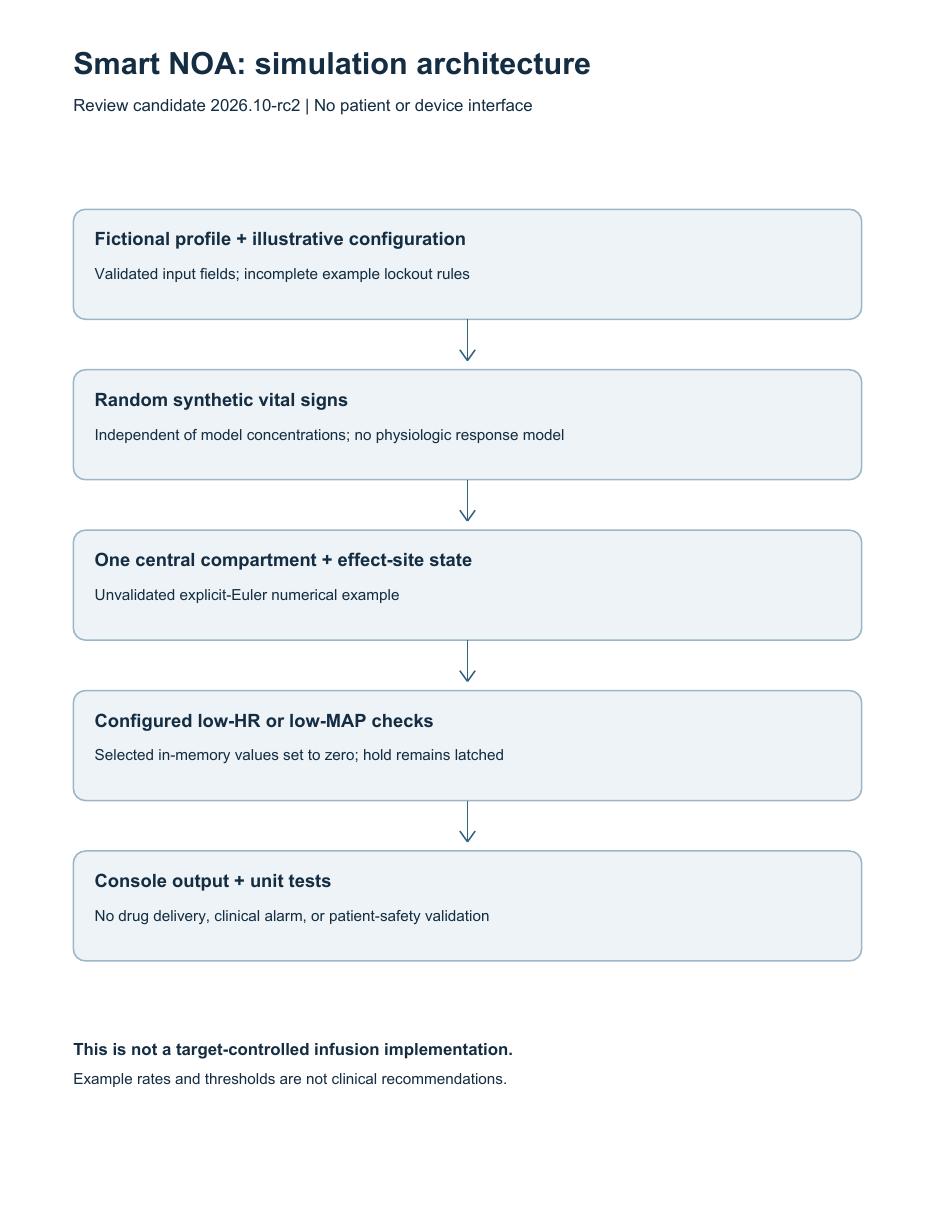
Architecture figure from 29 October 2026 (the date of commit aa522ab, which added it to this repository); predates the November 2026 interlock hardening; see the current diagram in SAFETY_DESIGN.md (above). The image is kept unchanged for the record.
2. Evidence and standards behind each principle
Each source below was checked on 7 November 2026 against its primary record: the full text where it could be read, the PubMed abstract where the claim is an abstract-level figure, or the publisher's page for paid standards (title and edition only). Section 5 gives the marking for each. Statements are limited to what those sources say. None of these sources evaluated Smart NOA.
| Principle in the simulation | What published evidence and standards say about real practice | Sources |
|---|---|---|
| Design for human error; make wrong doses harder (fail-safe, dose refusals, ceilings) | A critical-incident study of anaesthesia mishaps found human error involved in most of the preventable incidents it collected (82%), with overt equipment failure in only 14%; breathing-circuit disconnections, inadvertent changes in gas flow and drug-syringe errors were among the frequent problems. A prospective study at two hospitals reported about one drug administration error per 133 anaesthetics, the largest categories being incorrect doses and substitutions of IV boluses. A prospective observational study of 277 operations found that 193 of 3,671 medication administrations (5.3%, about 1 in 20) involved a medication error and/or adverse drug event, and that 153 of these (79.3%) were preventable. An APSF consensus conference called for a "new paradigm" for operating-room medication safety built on standardization, technology, pharmacy (prefilled/premixed) and culture. | [C1] [W1] [N1] [A1] |
| A clinician stays in the loop; the software never acts for them | The ASA monitoring standards require qualified anaesthesia personnel to be continuously present to monitor the patient during anaesthesia, and state that observing the standards "cannot guarantee any specific patient outcome." FDA guidance on clinical decision support distinguishes software that supports a clinician's independent review from software that directs care; claiming a clinical function is part of what can make software a regulated device. | [ASA] [FDA] |
| Explicit checkpoints before critical steps (WHO time-out is the clinician's) | In a before-and-after study in eight hospitals (patients aged 16 or over undergoing noncardiac surgery), introduction of the WHO Surgical Safety Checklist (sign-in, time-out, sign-out) was associated with lower rates of death (1.5% to 0.8%) and inpatient complications (11.0% to 7.0%). | [H1] |
| Alarms with priorities, few interruptions, nothing hidden (holds pause automatic modes; advisories are text only) | The Joint Commission's Sentinel Event Alert 50 named alarm fatigue as the most common contributing factor to alarm-related sentinel events (citing sources beyond its own database, where an absent or inadequate alarm system and improper alarm settings were the leading factors), and recommended that hospitals ensure a process for safe alarm management, inventory alarm-equipped devices and their default settings, and set guidelines for alarm settings. IEC 60601-1-8 is the international standard for alarm systems in medical electrical equipment. | [TJC] [IEC-A] |
| Time-stamped records and incident review | The Anesthesia Closed Claims Program, started in 1984 by the ASA and the University of Washington, analyses closed malpractice claims obtained from malpractice insurance companies to identify major patterns of injury and prevention strategies. | [CC1] |
| Risk analysis and controlled software development for real devices | Real medical devices are developed under a risk-management process (ISO 14971) and a software life-cycle process (IEC 62304). This simulation has followed neither and has not been assessed against either. | [ISO] [IEC-S] |
| What validated closed-loop systems require and show | A meta-analysis of randomized trials (12 studies, 1,284 patients) reported that closed-loop, processed-EEG-guided delivery of total IV anaesthesia used less propofol for induction, kept the target depth more of the time and shortened recovery compared with manual control, with no difference in induction time or total propofol dose. Those were purpose-built systems evaluated in clinical trials. This simulation is not such a system: it does not titrate anaesthesia, it has not been evaluated in patients, and its interlocks only stop or refuse. | [P1] |
3. Liability and insurance, in general terms
This simulation does not reduce anyone's liability or insurance costs; real reductions depend on validated, regulated devices and institutional practice.
In general, the sources above describe what risk management in anaesthesia is built on: standard-compliant monitoring with a qualified clinician present [ASA], checklists at critical points [H1], medication-safety measures such as standardization and technology [A1], managed alarm systems [TJC], documented records that allow incidents to be reconstructed, and systematic review of incidents and closed claims [CC1]. The Anesthesia Closed Claims Program was started in 1984 to analyse closed malpractice claims, identify major patterns of injury and inform prevention [CC1]. For devices, documented risk controls follow ISO 14971 and IEC 62304 [ISO] [IEC-S].
No verified source found for this page states a premium saving or a liability reduction from any of these measures, so none is given. How an individual insurer or institution weighs such measures is outside the scope of this educational page. Educational software that claims a clinical benefit can bring itself under medical-device regulation [FDA]; that is one more reason this page makes no such claim.
4. Limits
The same caveats as the model card:
- Not validated. No external validation has been performed, and simulator outputs have not been compared with patient data. Passing tests shows that the code does what it is written to do, not that it is clinically safe or effective.
- Illustrative physiology. Physiology and PK/PD are illustrative; most model constants are author estimates. The interlock thresholds, plausibility and drop limits, suspension length and long-hold interval are simulation settings, not clinical standards.
- Simulator conventions are labelled. Teaching ceilings, the dexamethasone-allergy lockout, eGFR as a stand-in for creatinine clearance, the advisory agent-selection rule and many timings are simulator conventions, each labelled as such in the code, the model card and the source registry.
- No clinical sign-off. No independent clinical (anaesthesiologist) review has been recorded.
- The program has no device interface and must not be connected to equipment or used with real patient information.
5. Sources
Verification, 7 November 2026, from the owner's machine (no bot challenge was bypassed): journal articles against the NCBI PubMed record (E-utilities; abstract, authors, journal, volume, pages, DOI) and, where available, the full text in PubMed Central; society, regulatory and standards pages in a normal browser; the Joint Commission alert and the FDA guidance read in full from their official PDFs. Markings: confirmed against the full source (the full document was read); confirmed against the PubMed abstract (the claim is an abstract-level figure and the abstract matches); title and edition confirmed on the publisher's page (paid standards; full text not opened).
- [C1] Cooper JB, Newbower RS, Long CD, McPeek B. Preventable anesthesia mishaps: a study of human factors. Anesthesiology. 1978;49(6):399–406. doi:10.1097/00000542-197812000-00004. PMID 727541. Supports: 47 interviews and 359 preventable incidents; "most of the preventable incidents involved human error (82 per cent)"; "overt equipment failures constituted only 14 per cent"; frequent problems included breathing-circuit disconnections, inadvertent changes in gas flow and drug-syringe errors. Confirmed against the PubMed abstract.
- [W1] Webster CS, Merry AF, Larsson L, McGrath KA, Weller J. The frequency and nature of drug administration error during anaesthesia. Anaesthesia and Intensive Care. 2001;29(5):494–500. doi:10.1177/0310057X0102900508. PMID 11669430. Supports: two hospitals; 7,794 forms returned from 10,806 anaesthetics; error rate 0.0075 per anaesthetic, "one drug administration error was reported for every 133 anaesthetics"; the largest categories were "incorrect doses (20%) and substitutions (20%) with i.v. boluses". Confirmed against the PubMed abstract.
- [N1] Nanji KC, Patel A, Shaikh S, Seger DL, Bates DW. Evaluation of perioperative medication errors and adverse drug events. Anesthesiology. 2016;124(1):25–34. doi:10.1097/ALN.0000000000000904. PMID 26501385; PMC4681677. Supports: prospective observational study; 277 operations, 3,671 medication administrations; 193 (5.3%; 95% CI 4.5–6.0) involved a medication error and/or adverse drug event ("one in 20"); 153 (79.3%) preventable. Confirmed against the full source (PubMed Central full text).
- [A1] Eichhorn JH. APSF Hosts Medication Safety Conference. APSF Newsletter. 2010;25(1) (posted 10 June 2010). https://www.apsf.org/article/apsf-hosts-medication-safety-conference/ . Supports: on 26 January 2010 APSF convened a consensus conference of 100 stakeholders; the proposed new paradigm to reduce harmful operating-room medication errors "is based on Standardization, Technology, Pharmacy/Prefilled/Premixed, and Culture (STPC)". ("Medication Safety in the Operating Room: Time for a New Paradigm" is the conference theme and the title of APSF's video.) Corroborated by Samost-Williams A, Cooper J, Abcejo A, Rebello E. APSF's Forty-Year Commitment to Medication Safety in Anesthesia. APSF Newsletter, 1 October 2025. Confirmed against the full source.
- [ASA] American Society of Anesthesiologists. Standards for Basic Anesthetic Monitoring. Original approval 21 October 1986; last amended 15 October 2025. https://www.asahq.org/standards-and-practice-parameters/standards-for-basic-anesthetic-monitoring . Supports: Standard I, qualified anesthesia personnel "shall be present in the room throughout the conduct of all general anesthetics, regional anesthetics and monitored anesthesia care … shall be continuously present to monitor the patient and provide anesthesia care"; the preamble, the standards "are intended to encourage quality patient care, but observing them cannot guarantee any specific patient outcome." The same standard is source S22 of the simulator's registry. Confirmed against the full source.
- [H1] Haynes AB, Weiser TG, Berry WR, et al. A surgical safety checklist to reduce morbidity and mortality in a global population. N Engl J Med. 2009;360(5):491–499. doi:10.1056/NEJMsa0810119. PMID 19144931. Supports: eight hospitals in eight cities; patients aged 16 or over undergoing noncardiac surgery; 3,733 patients before and 3,955 after; death 1.5% to 0.8% (P = 0.003); inpatient complications 11.0% to 7.0% (P < 0.001). Confirmed against the PubMed abstract.
- [TJC] The Joint Commission. Sentinel Event Alert, Issue 50: Medical device alarm safety in hospitals. 8 April 2013. https://www.jointcommission.org/en-us/knowledge-library/newsletters/sentinel-event-alert/issue-50 . Supports: alarm fatigue named as the most common contributing factor among the contributing factors the alert cites in addition to its own Sentinel Event database (within that database the leading factors were an absent or inadequate alarm system, 30, and improper alarm settings, 21); recommendations that leadership ensure a process for safe alarm management, that organisations inventory alarm-equipped devices and their default settings, and that they set guidelines for alarm settings, including when alarm signals are not clinically necessary. Confirmed against the full source (official PDF).
- [IEC-A] IEC 60601-1-8:2006+AMD1:2012+AMD2:2020 CSV, Medical electrical equipment – Part 1-8: General requirements for basic safety and essential performance – Collateral Standard: General requirements, tests and guidance for alarm systems in medical electrical equipment and medical electrical systems. Consolidated edition 2.2, 23 July 2020. Cited by title and edition only. Title and edition confirmed on the publisher's page (IEC webstore).
- [CC1] Cheney FW. The American Society of Anesthesiologists Closed Claims Project: what have we learned, how has it affected practice, and how will it affect practice in the future? Anesthesiology. 1999;91(2):552–556. doi:10.1097/00000542-199908000-00030. PMID 10443619 (no abstract). Article not yet confirmed against the full source (the publisher's site showed a bot challenge, which was not bypassed). The program facts used on this page are confirmed on the ASA's own page: American Society of Anesthesiologists, Anesthesia Closed Claims Program (under the Anesthesia Quality Institute since 2019), https://www.asahq.org/aqi/registries/closed-claims — started in 1984 by the ASA and the University of Washington at Seattle "to analyze closed malpractice claims"; goal: to identify major safety patterns of injury and prevention strategies; data from "malpractice insurance companies". Confirmed against the full source (the ASA page).
- [ISO] ISO 14971:2019, Medical devices — Application of risk management to medical devices, edition 3, December 2019 (status: confirmed). Cited by title and edition only. Title and edition confirmed on the publisher's page (iso.org, standard 72704).
- [IEC-S] IEC 62304:2006+AMD1:2015 CSV, Medical device software – Software life cycle processes (Amendment 1 published 26 June 2015; consolidated publication 22794; stability date 2028). Cited by title and edition only. Title and edition confirmed on the publisher's page (IEC webstore).
- [FDA] U.S. Food and Drug Administration. Clinical Decision Support Software: Guidance for Industry and Food and Drug Administration Staff. Final guidance, January 2026 (issued 29 January 2026; supersedes the 6 January 2026 and 28 September 2022 versions). Docket FDA-2017-D-6569. https://www.fda.gov/regulatory-information/search-fda-guidance-documents/clinical-decision-support-software . Supports: certain CDS software functions are excluded from the device definition only if they meet "all of the following four criteria", including software "intended for the purpose of enabling an HCP to independently review the basis for the recommendations … so that it is not the intent that the HCP rely primarily on any of such recommendations". Confirmed against the full source (official PDF).
- [P1] Pasin L, Nardelli P, Pintaudi M, et al. Closed-loop delivery systems versus manually controlled administration of total IV anesthesia: a meta-analysis of randomized clinical trials. Anesth Analg. 2017;124(2):456–464. doi:10.1213/ANE.0000000000001394. PMID 28099320. Supports: 12 randomized trials, 1,284 patients; closed-loop delivery used less induction propofol, kept the target depth more often and shortened recovery; no difference in induction time or total propofol dose. Confirmed against the PubMed abstract.
Suggested in the build request but not used: other closed-claims publications on medication errors (no specific record could be checked in this pass).
6. How this page was made
AI assistance: used in drafting, revision and checking (the site's current wording). No independent clinical sign-off is recorded. The owner is responsible for the content. The diagrams are generated from the engine configuration as described in section 1; the source records above were checked on 7 November 2026 as stated.
README · Reader's guide · Web simulator README · Model card · Source registry